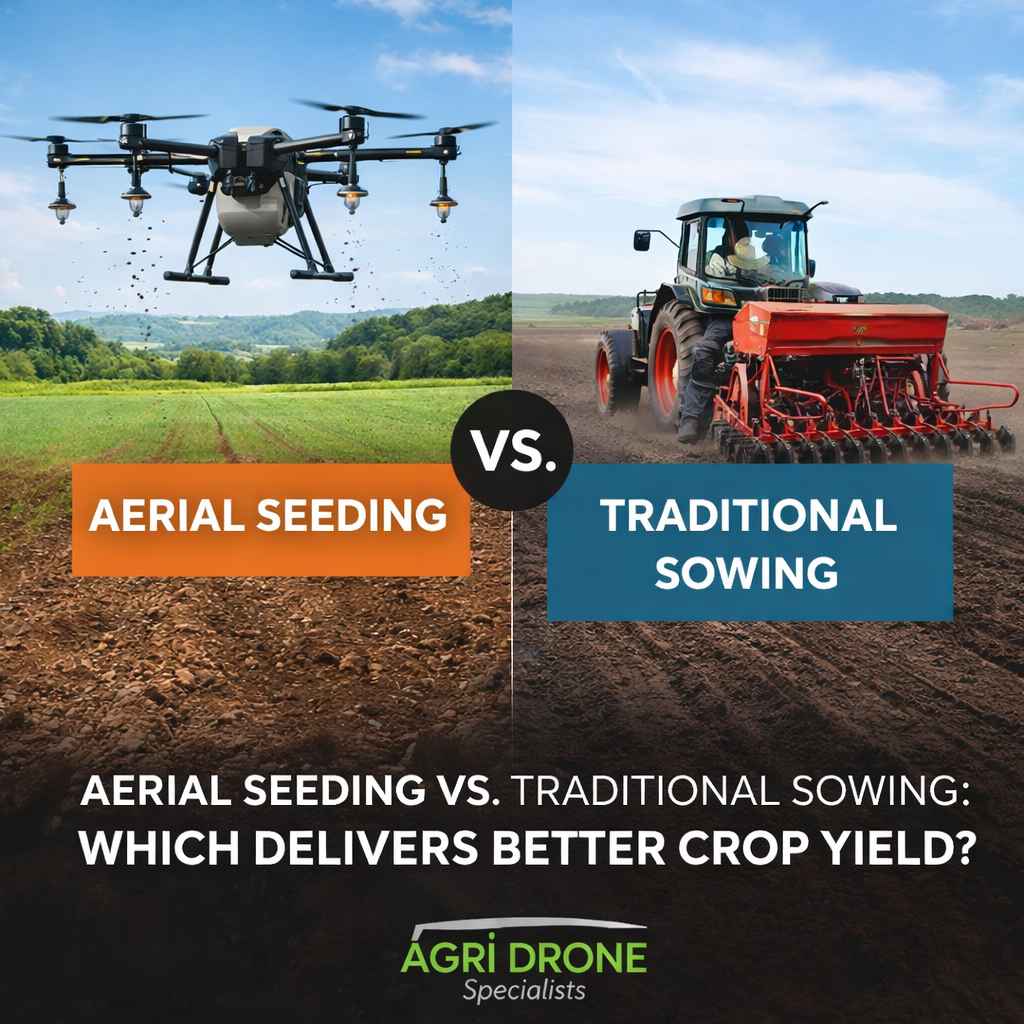
Modern agriculture is rapidly evolving. The demand for Aerial Seeding is increasing among farmers and others who want ways to increase productivity, reduce labour costs, and maximize land use. Sowing depends on either manual labour or machines. Still, the constant increase of pressure on land, unpredictable climate, and ever-rising operational costs have led many to adopt other seeding solutions.
In this post, we will compare the drone seeding method and traditional sowing to determine which one produces the highest yield in the fast-paced agricultural landscape.
What Are the Traditional Sowing Methods
The traditional sowing methods are seed broadcasting, seed drilling using tractors, and precision planting machines. Although these techniques have been the backbone of farming for decades, they come with several limitations:
• High labour and machinery costs.
• Very long processes, especially for large farms.
• Soil compaction due to heavy machinery.
• Uneven, wet, or steep terrain access difficulties.
• Inconsistent seed distribution in certain field conditions.
What Is Aerial Seeding?
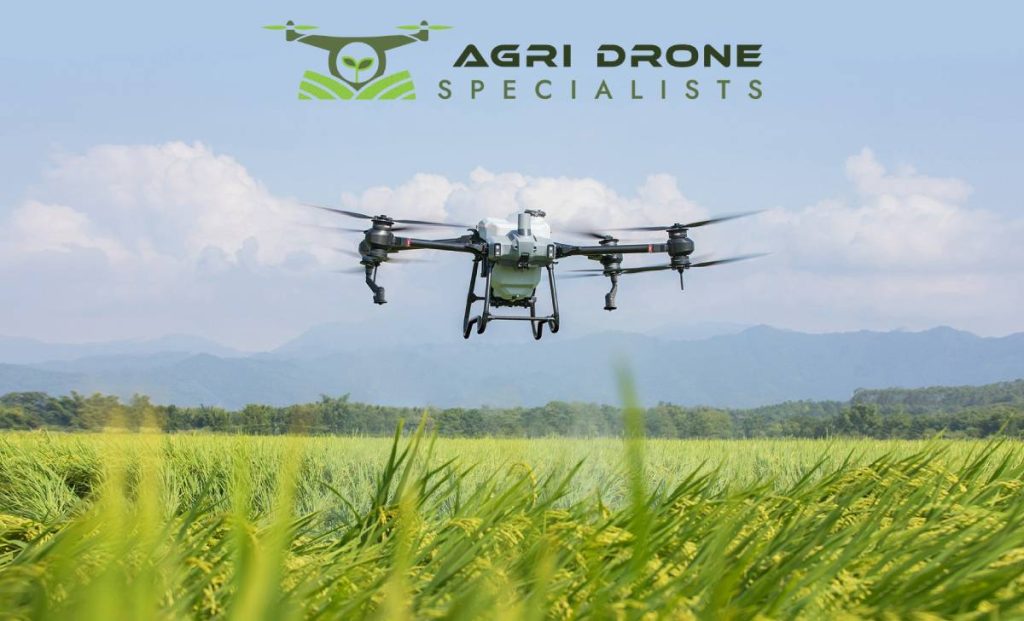
Aerial or drone seeding is a contemporary method of scattering seeds from an aerial view. Combining GPS and drones with high-capacity spreaders, the seeds are distributed over the fields shortly and uniformly. This method finds widespread application in pasture regeneration, cover cropping, reforestation, and large-scale cropping, each at its own pace.
The high precision and rapidity of this seeding method render it especially advantageous for farms with large or rugged terrain where traditional machines cannot operate efficiently.
With the latest DJI T100 with a capacity of 150 litre or 100 kg load, high rates are not a problem.
Comparing Crop Yield: Aerial vs. Traditional Sowing
1. Seed Distribution & Accuracy
• Traditional Sowing: The seed drills ensure accurate placement, but due to uneven terrain, soil moisture, and machinery limitations, some patches might be missed, or depth inconsistencies might occur.
• Aerial Sowing: Drones guarantee uniform seed distribution over the entire field. Their capacity to adhere to exact GPS paths ensures even coverage, less seed wastage, and supports the emergence of the crop.
Winner: Aerial Sowing, especially over varied terrains.
2. Soil Health & Root Development
• Compaction of soil occurs due to the use of heavy tractors in the traditional method of sowing; this lowers the aeration, and roots get restricted in their development.
• Aerial sowing disallows any soil disturbance, and that helps in the sound structure of the soil and moisture retention, which are the two factors in improving yield potential.
Winner: Aerial sowing, mainly for the long-term health of the soil.
3. Accessibility to Difficult Land
• Traditional equipment fails to work efficiently in areas that are steep, muddy, rocky, or waterlogged.
• Aerial Sowing, on the other hand, is very efficient; no slopes, gullies, or inaccessible land will be left unproductive because it can be covered easily.
Winner: Aerial sowing, no doubt about it.
4. Speed & Efficiency
• Traditional sowing on vast lands can take from a few days to a couple of weeks.
• Aerial Sowing can be done in hours, covering large areas, and thus becoming the best solution for time-sensitive planting seasons.
Winner: Aerial Sowing, particularly in the case of critical seasonal peaks.
5. Cost Effectiveness
• Traditional sowing needs fuel, machine upkeep, human resources, and time.
• Aerial Sowing cuts down labour requirements, thereby avoiding heavy equipment costs, which are among the reasons why it is often cheaper in the long run.
Winner: Aerial Sowing, in terms of cost and operational efficiency.
Which One Delivers Better Crop Yield?
Aerial seeding is a method with significant advantages for vast farms and hard-to-reach terrains to deal with rising labour costs. The process results in healthier soil, optimum seed utilization, and quicker coverage—all of which indirectly lead to the production of higher and more stabilized yields.
Productivity, accuracy, and sustainability are increasingly important; aerial sowing represents a significant opportunity to achieve the highest potential yield for crops.
At Agri Drone Specialists, our advanced aerial seeding program enables farmers to increase yields, decrease costs, and maximize efficiencies. Our drones are equipped with the latest technology to provide highly accurate and comprehensive seed placement over all types of land.
We offer you the following:
• Customised seeding plans
• High-capacity drone application
• GPS-guided flight precision
• Post-seeding reporting and monitoring
Whether you’re establishing new pastures, planting cover crops, or planting a large acreage all at once, Agri Drone Specialists will be there to support you with state-of-the-art aerial or drone seeding technology. Contact us today, and let us show you how Aerial Seeding can help you grow more food and be more sustainable.